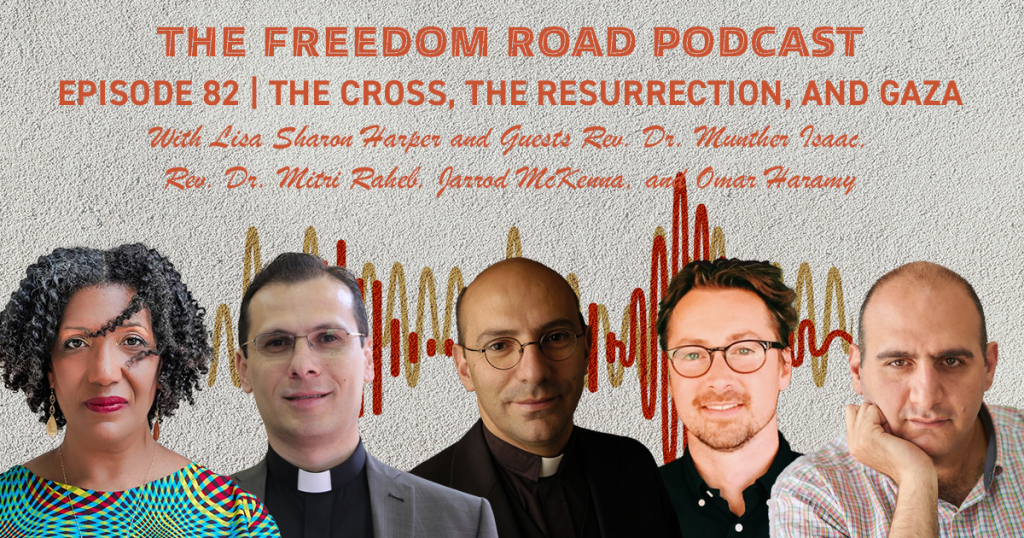
In this episode
This episode comes to you in partnership with Inverse Podcast. The diverse InVerse podcast community explores how the Scriptures can turn the world upside down, or be weaponized to uphold the status quo. So, this episode we’re going to talk the “T” word—theology. Theology is simply how we understand God and our relationship with God. Christian social ethics teaches that our understanding of God forms the basis for everything we do in the world. It impacts everything.
This will we be a very special deep dive into the theo-ethical questions rising in the context of the genocide in Gaza. We will talk with three leading Palestinian Christian theologians as they approach Good Friday and Easter Sunday in the context of genocide.
Rev. Dr Mitri Raheb is Founder and President of Dar al-Kalima University in Bethlehem. The most widely published Palestinian theologian to date, Dr. Raheb is the author and editor of 50 books including: Decolonizing Palestine: The Land, The People, The Bible; In the Eye of the Storm: Middle Eastern Christians in an Age of Empire and Faith in the Face of Empire: The Bible through Palestinian Eyes—among many, many others.
Rev. Dr. Muther Isaac is Pastor of the Christmas Evangelical Lutheran Church in Bethlehem and Dean of Bethlehem Bible College. Rev. Dr. Munther is the author of The Other Side of the Wall: A Palestinian Christian Narrative of Lament and Hope.
Omar Haramy, is an Arab, Palestinian, Jerusalemite, Christian, and Greek Orthodox. Since 2017, Omar has served as the director of the Sabeel Ecumenical Liberation Theology Center. Sabeel is a Palestinian ecumenical grassroots liberation theology movement that deepens the faith of Palestinian Christians, promotes unity among them, and guides them to engage for justice and peace. Omar also serves on the Kairos Palestine steering committee.
Our Inverse Podcast cohost today will be Jarrod McKenna, a peace award winning Australian pastor and social change educator who has been described by American Civil Rights legend Rev. Jim Lawson as “an expert in nonviolent social change”. Jarrod is the Founding Director of “Common Grace” that represents over 65,000 Christians in Australia pursuing “Jesus and justice” and serves with Lisa as one of the co-founders of the global GazaCeasefirePilgrimage.com movement that is now found on every continent, including Antarctica, in over 150 cities around the world.
We’d love to hear your thoughts. Thread or Insta Lisa @lisasharper or to Freedom Road @freedomroad.us. We’re also on Substack! So be sure to subscribe to freedomroad.substack.com. And, keep sharing the podcast with your friends and networks and letting us know what you think!
www.threads.net/@lisasharper
www.threads.net/@freedomroad.us
freedomroad.substack.com
www.inversebible.org/podcasts
www.gazaceasefirepilgrimage.com/
Transcript
Lisa Sharon Harper: [00:00:00] Coming to you from Philadelphia, Pennsylvania, the city of brotherly love and sisterly affection. I’m Lisa Sharon Harper. Presidents of Freedom Road, a consulting group dedicated to shrinking the narrative gap. Welcome to the Freedom Road podcast. Each episode, we speak with national and global faith leaders, advocates, scholars, artists, and activists to have the kinds of conversations we normally have on the front lines.
It’s just that this time we’ve got microphones in our faces and you are listening in. And this episode comes to you in partnership with Inverse Podcast. The diverse Inverse Podcast community explores how the scriptures can turn the world upside down or be weaponized to uphold the status quo. So this episode, we’re going to talk the T word, [00:01:00] theology.
Theology is simply how we understand God and our relationship with God. Christian social ethics teaches that our understanding of God forms the basis for everything that we do in the world. It impacts it all. This will be a very special, deep dive into the theoethical questions rising in the context of the genocide in Gaza.
We will talk with three leading Palestinian Christian theologians as they approach Good Friday and Easter Sunday in the context of genocide. Reverend Dr. Mitri Raheb, founder and president of Dar al Kalima University in Bethlehem is the most widely published Palestinian theologian to date. Dr. Raheb is the author and editor of 50 books, including Decolonizing Palestine: The Land, The People, The Bible, [00:02:00] In the Eye of the Storm, Middle Eastern Christians in an Age of Empire, and one that I came across while writing The Very Good Gospel, Faith in the Face of Empire: The Bible through Palestinian Eyes among many, many others.
Reverend Dr. Munther Isaac is the pastor of the Christmas Evangelical Lutheran church in Bethlehem and the Dean of Bethlehem Bible college. Reverend Dr. Munther is the author of The Other Side of the Wall, a Palestinian Christian narrative of lament and hope.
Omar Haramy is an Arab Palestinian, Jerusalemite, Christian, and Greek Orthodox. Since 2017, Omar has served as the director of the Sabeel Ecumenical Liberation Theology Center. Sabeel is a Palestinian ecumenical grassroots liberation theology [00:03:00] movement that deepens the faith of Palestinian Christians, promotes unity among them, and guides them to engage for justice and peace. Omar also serves on the Kairos Palestine Steering Committee.
My Inverse Podcast co host today will be Jarrod McKenna. Jarrod is a Peace Award winning Australian pastor and social change educator who has been described by American civil rights legend, Reverend Jim Lawson, as quote, an expert in nonviolent social change.
Jared is the founding director of Common Grace. It represents over 65,000 Christians in Australia pursuing Jesus and justice and serves with me as one of the co-founders of the Global Ceasefire Pilgrimage. com movement. This is now found on every continent including Antarctica. Yes y’all, you [00:04:00] heard me right, Antarctica.
Where someone is actually on their treadmill walking 20 miles in solidarity with the people of Palestine. And this movement is now in over 150 cities around the world in 19 countries. So we would love to hear your thoughts. So please tweet to me at Lisa S. Harper or to Freedom Road at Freedom Road Us or to Inverse, and when you see tweet, you should actually read Thread or Insta or Facebook, not so much on the tweeting machine recently.
And keep sharing the podcast with your friends and networks and letting us know what you think. All right, let’s dive in.
So our first question is for everyone. And it’s a very basic question because quite honestly, the, you know, we’re not, we don’t normally do deep theology on Freedom Road, but I also see the need for it, especially theoethics. [00:05:00] And so I want to ask you all, what is theology to you?
Omar Haramy: Maybe because I’m not a theologian, it’s easier for me to answer.
So, I think theology is, is like the simplified version. The answer for me, it is, it’s questions, um, it’s the questions that we have. It’s questions about our relationship with the Creator, the greater being. How should this relationship look like, but it’s also the relationship questions about the relationship between me and my neighbor.
So it’s a, it’s in a way, it’s a cross, it’s a horizontal and a vertical relationship. So that is what theology is for me. It’s plenty of questions, very little answers.
Lisa Sharon Harper: I appreciate that. Well, that’s really good.
Mitri Raheb: And for me, it’s really.[00:06:00] for people of faith to try to make sense of the world and what’s happening around us.
Lisa Sharon Harper: Wow, that’s fabulous. Doctor, and also, I’m sorry folks, make sure that you announce who you are as you are speaking, especially in this first segment so folks can get to know your voices. So that was Dr. Mitri Rahab. How about you Munther?
Munther Isaac: Yeah, for me maybe my understanding is closer to what Omar said, and I’ll put it in more biblical language.
It’s how to love God and how to love neighbor. So, uh, trying to answer these 2 questions, how do we love God from all of our beings? And how do we practice our love to our neighbors as ourselves? Uh, if we can figure out these 2 things, I think we’re very good theologians.
Lisa Sharon Harper: Fabulous. Next question, and then I’m going to pass it to [00:07:00] Jarrod.
Who are your theological sheroes or heroes? We’re the people that you reference a lot, or you think, like, who have helped to form your understanding of God.
Munther Isaac: To me personally. It actually took me a while to liberate myself from understanding the Bible and God through Western lens.
Lisa Sharon Harper: Okay.
Munther Isaac: You know, my first seminary encounter was in Philadelphia, it was administered and it was very Presbyterian, very reformed, very conservative growing up. I grew up in an evangelical church and evangelicalism and its definition comes with a Western focus on individualism, a contrast between the evil world and the holy church and separation, even from the world.
[00:08:00] It took a while until, you know, I was more exposed to theologies from contexts of oppression and in that liberation. And I remember the first, really exposure to that was Naim Ateek’s Book For Justice and Only Justice, a Palestinian Theology of Liberation. But then after that throughout my theological career, engaging with whether South Africans or even people from Sri Lanka, and you begin to develop the sense that this is different.
Yet the most impact, I would say, did not come from reading theology books, but from listening to sermons of my predecessor at Christmas Lutheran Church, our co-guest, Reverend Mitri Raheb, who himself can speak about his journey. But I think, [00:09:00] when you preached in the context of intifada in the context of apartheid, in the context of violence, You have to make sense of the Bible, and I think he mastered that in his sermons that brought the life… the Bible to life in a really fresh and different way. So this is to me the best, the most impact on my thinking was through those sermons.
Lisa Sharon Harper: Wow.
Munther Isaac: Yes, you can tell more about those sermons.
Lisa Sharon Harper: Yeah, I think he just pitched it to you, Mitri.
Mitri Raheb: Yeah, I think, um, for me, you know, I studied in Germany, theology, and I think, uh, during those eight years.
Uh, I was impressed with Dietrich Bonhoeffer who really under Hitler [00:10:00] understood that we have to resist the form of oppression, and we cannot, even if the whole church was going astray and was really, uh, backing, not the whole, but the majority of people in the church were backing Hitler.
He sought a different, I would say prophetic, role at his time. And so, he became important during my studies in Germany. But as also Reverend Munther said, I think more and more I started to listen to Asian-American, feminist theologians, South African, but also [00:11:00] some, you knowI mean, Palestinian theologians, colleagues of mine that really opened up to me a new dimension, really to have the courage, not just to imitate what Western theologians were saying, you know, ’cause there was a time when we thought, you know, Western theology is their real theology. And what we do in the global south is contextual theology as if the western theology is not contextual.
Lisa Sharon Harper: That’s right.
Mitri Raheb:And so I always. Like to say, you know, there are no contextless theologians because contextless theology is totally irrelevant. Uh, the difference is only between those who know what they are doing is contextual and those who don’t know yet. But hopefully we pray for them that they will [00:12:00] come when they will know that.
Lisa Sharon Harper: Amen. Wait, lemme, I just wanna sit on something you just said very quickly. You said. Theology without a context is irrelevant. Is that what you said?
Mitri Raheb: Yes.
Lisa Sharon Harper: Did I hear that right?
Mitri Raheb: Yes.
Lisa Sharon Harper: I just want, everybody just please sit in that for a minute. That basically means there is no, like, objective, let’s go, let’s go buy our theology at Walmart and take it out of a box and it works for everybody, right?
So you have to figure out what is your context. So Omar, please share with us, how are you thinking about theology? And who’s, who are your, who are your sheroes and heroes?
Omar Haramy-Sabeel: I mean, basically, Reverend Mitri Rahib, Reverend Munther, Reverend Naim, Jean Zaru, there’s plenty of people here in Palestine that are really doing theology the hard way.
[00:13:00] You know, live when, when you’re just living under occupation, you’re able to do, and there’s so many, or if you’re part of a church that is under persecution, when you write theology, I think theology is more meaningful, because it’s, this theology is the theology of people who are ready to be martyrs and to make sacrifices.
And I mean, especially when you are in a context like Reverend Mitri, who was in Germany, it’s a very difficult, hostile environment for theology, if, especially if you’re outside the norms of Europe and Germany. But for me, it is, it’s like really where I really love the theological revolution.
It is, it’s actually in Christmas. And it’s actually from the, when the, when the world became flesh, you know, it is, it’s moving us as humanity from people who are sacrificing the most precious to God, to the divine, and not only this, it’s like we move [00:14:00] from the mentality of being the slaves of the Creator, to becoming, to having, to believing in a Creator that is willing to come and live among us, and to serve us, and to die for us.
This theological revolution that God becomes a servant for humanity is not only very revolutionary at the time of Jesus, but it is still very revolutionary. It is. They might people, many places around the world, they say, this is the heresy. This is, you know, you’re a heretic for believing this. How could you challenge the almighty to come?
But that’s the theological message of Bethlehem. That’s the theological message of Christianity. And for me, this is why it’s, I like, I love the gospel of John, a lot, the Eagle of theology, the one who tries to show us. That the rule, the real intention of theology of serving, you know, it’s your neighbor.
I don’t know if loving your neighbor. I’m not so eager at loving my neighbors as, Reverend Munther has a bigger heart than me. [00:15:00] And he went to seminary, I did not, but I think it is. It’s maybe it is. It’s just how living with your neighbor. I don’t think we’re called to love each other, but it is, is how can we live with each other?
Lisa Sharon Harper: Wow. Thank you so much, Jared. What do you have for us?
Jarrod McKenna: Well, brother Omar has set us up beautifully for my next question. In the words of Martin Luther King, in his last Christmas sermon, we’ve got to connect Christmas to Easter. So if we can stay with what it is to take the incarnation seriously and consider the life of our Lord, not as a segregated interest as we talk about the cross and resurrection, but as a summation of the life, the ministry, the teachings, the miracles of our Lord, I would love to give you all an opportunity to talk about a theology of Easter in the context of occupation, apartheid policies, genocide, house [00:16:00] demolitions.
I mean, the list goes on in terms of what Palestinians experience on a daily basis. But before we get to that, I’m also aware that ancient Christianity and Eastern Christianity orthodoxy still continues to emphasize that to talk of the cross and resurrection is to talk of a mystery.
And I, I, um, I would love to hear what motifs and, uh, uh, what imagery, uh, what iconography is, Empowering for Palestinian people. But before we get there, can I ask what ways of talking about the cross and resurrection aren’t good news for Palestinian people? Can I ask that question first around what theologies have you encountered or continue to encounter that actually take away from the power of the gospel?
Lisa Sharon Harper: Wow, that’s good.
Munther Isaac: Mitri, you wrote a book on the cross.
Mitri Raheb: Yeah, but, um, yeah, I think, [00:17:00] as Palestinians, as you know. The Bible is not necessarily a good news for us for many Palestinians. It sounds as if it were bad news because God is promising your land, your homeland to another people who happens to be your oppressors.
And you have to be happy with that. Not even that only, but, you know, God, in his intention wanted these oppressors to have supremacy. And that at the end of the day, the fact that Jesus was Jewish is [00:18:00] used against us Palestinian today as if to being Jewish means immediately anti-Palestinian, and they forget that actually Jesus was a Palestinian brown Jew, but Palestinian here is important because he was, he was like us, a person born in Palestine, crucified in Palestine, rose in Palestine, and Palestine has been always a place where people of different, people of different faith were coexisting.
So, at least, and until today, we have Jews, Christians and Muslims and ____ and Samaritans and you name it. And there is no contradiction between one’s religion and, the belonging to the [00:19:00] land. And so this is really, what, how the Bible was used: weaponized against us. But I have to say, in terms of the cross, we have also to be aware that, unfortunately, the church weaponized the cross against the Jewish people in a very also, a bad way, in a very racist way.
And so we have to overcome those two weaponizations if we really want to move forward.
Jarrod McKenna: Wow. Well, I just got my money’s worth. Thank you.
Munther Isaac: And let’s not forget how the cross also as a symbol was weaponized against the audience through the crusades. But when I think of Easter and what it means, and for us as [00:20:00] Palestinians, it’s a very relevant story.
And before we talk about the mystery of Jesus dying for our sins, and as being crucified with him and risen in him, all of that Pauline theology, let us remember that the crucifixion was at the climax of the gospel narratives. In which Jesus spent his earthly ministry in confrontation with both the political and religious institutions and to a certain degree, the social fabric of his time, and he challenged all three and ended up dying as a victim of the violence.
Of both the empire and the religious institution. So when we talk about religious extremism or what we talk about, the ruthlessness of empire [00:21:00] today, Jesus experienced that. And in that sense, he is in the full sense of the world in solidarity with us as Palestinians. Actually, we see him as one of us, not just as a political or ideological identity, but in terms of living the same experience.
When he died on the cross, he was a victim of injustice. He didn’t do anything to merit his execution in such a brutal way. And he experienced many things on the cross that we also experienced today as Palestinians. His friends abandoned him when he was arrested. This is the very same feeling we feel today abandoned by many.
You know, Peter followed him from distance. I preached about this this Sunday. As if he was more afraid about himself. But he wanted to see what happens with Jesus. You know, we see many [00:22:00] churches watching this genocide and was about from distance.
Lisa Sharon Harper: That’s right.
Munther Isaac: But they’re more concerned about themselves, about their own security.
They don’t want to get into any controversy. And then on the cross, maybe this is the hardest of all. He experienced the silence of God when he cried, my Lord, my Lord, Why have you forsaken me? A very familiar prayer. We pray as Palestinians. We pray over history, but we pray even today in this as this genocide continues to unfold in front of our eyes.
We ask this question. People ask me this question all the time. Where is God? So you see how relevant this experience is. And the holy week when we meditate on these elements of the story, we as Palestinians feel that we live them, they become part [00:23:00] of our lived experience, especially as Palestinian Christians.
But then Easter Sunday is important. We have a saying here in Palestine that our Good Friday has lasted way too long. We can’t wait for Sunday to come, but we can’t decide that Sunday will come. And every Easter Sunday, I remind myself and our church that the resurrection reminds us that the last word belongs to God. The last word is for justice, for life, for truth, for light. We can’t lose sight of that because if we lose sight of that, we will live in despair. And even though our Friday has lasted way too long, we have to endure. This is the Palestinian resilience. So more because we know that ultimately Sunday will come and life will overcome [00:24:00] death.
Omar Haramy-Sabeel: Actually today I was listening to a different podcast and I mean on the podcast it was like more related to science. And actually it’s, that’s a fun fact is that 99 percent of what we, our bodies and what we see around us was actually, was produced inside the inner suns billions of years ago. And I mean, this is where carbon is formed and all of the heavier metals. And we see what we see around us was actually manufactured in… inside stars that then came to die and explode. And we are made of stardust. So the relationship between death and life is very much connected. I mean, with Easter and Christmas in general, you know, when we see it here in Palestine with the plants when fruits [00:25:00] drop from trees and fruits die, you know, the seeds of the dead fruit some, you know, they grow and they become new trees.
So death and life are very much connected. The cross is not only, you know, it is, it’s from a Western perspective, yes, the cross has been used, especially in recent history, a few centuries, since some centuries, been used as to… as a symbol of the Crusades, a symbol of colonialism, because empires were mainly found in the West.
But actually, for many of us in the churches of the East, the cross was also a symbol of persecution. We were being persecuted because of the cross today and sadly in Jerusalem when we walk in the old city, especially when there are religious, right-wing Israelis passing by, they spit on us, the cross becomes as a reason to be persecuted.
And the same thing [00:26:00] in many places, sadly, in the Middle East. So it’s really depends, you know, if it’s from our perspective, the cross is… and is a symbol that we happily associate with.
Mitri Raheb: Can I add something on regarding the cross, maybe? Because, you know, if there is one symbol that best tell the story of Palestine, it is the cross.
There is no other symbol. And this is why, uh, you know, being the president of a university that is focusing on the arts. Muslim artists, almost the majority of them had paintings with a cross where you would see, I mean, this is not part of [00:27:00] Islamic theology. But still. And you have, on the cover of the book behind you, Jarrod.
You have that one painting with one of the top three Palestinian artists who is a Muslim, Nabil Anani, so why would all of these important artists, depict the cross? Because the cross tells our story. We can identify with the crucified. This is our history. This is what’s happening in Gaza today.
We experience exactly this, to hang, between, you know, heaven and earth, it’s like lynching almost, that the African American, [00:28:00] experienced, and, but the other thing also, our forefathers and foremothers, you have all the important books there, but also our forefathers and foremothers, were able to spot God where nobody else was able to spot him.
Jarrod McKenna: Wow.
On the cross, where you think Jesus was totally isolated. He was totally abandoned, but our forefathers and foremothers, they were able to spot their God like nobody else, which really meant there is no place where we cannot experience God, uh, closeness to us. And so the moment that, uh, that Christ, uh, cried, uh, my God, my [00:29:00] God, why did you forsake me?
God was closest to him. And this actually made… took from the cross that, you know from suffering also that, um, you know, the I’m not sure what’s the English word, but it took from it. That sense that it has the last word as yes, that’s it.
Lisa Sharon Harper: These are our stories. You’re listening to the Freedom Road podcast, an inverse podcast, where we bring you stories from the front lines of the struggle for justice.
So I’d like to pick back up, um, where we left off at the cross. You mentioned, Dr. Mitri, James Cone. And [00:30:00] really the, well, you mentioned lynching and it made me think of James Cone’s The Cross and the Lynching Tree. Yes. And you might remember in, in Dr. Cone’s I mean, truly, for me, mind blowing, theological work in that book, he equated or, or brought the African American experience in parallel with the lynched Jesus.
And he began to help us to see that Jesus was lynched. We understand lynching. We don’t necessarily understand crosses. You know, we have to go to class to understand the political ramifications of a cross, but in America we understand lynching. So when he said, Jesus… or the cross and the lynching tree, we got that.
And he, in that book, Dr. Cone connected. The African-American experience as one that is sacrificed for [00:31:00] the prosperity of the empire, the prosperity of the oppressor. Black folk are lynched, are sacrificed for the prosperity of the lyncher. And so I want to ask you, as you think about Palestinian people, the Palestinian people, and you just yourself said it, you identify with the cross as, as a kind of a lynching tree.
How do you understand the sacrifice of Palestinians happening? How does the cross connect with your lynching tree?
Munther Isaac: Yeah, I think, and I’ve said this recently, in many ways, we asked Palestinians, and we asked Palestinian Christians have been sacrificed on the altar of first atonement of the Western world when it comes [00:32:00] to making amends for the sense of anti-Semitism, you have the Western world repenting on our land for a sin that took place on their land rather than dealing inwardly with the sense of anti-Semitism and white supremacy.
They exported the problem to Palestine and exchange it with ironically a support for another exclusive ideology, which is Zionism, which resulted now in a system of apartheid. And so the West is the response to their own anti-Semitism was the unconditional support to Zionism, and proof that they did not deal inwardly with their own racism towards others is the fact that we feel this racism was now pointed towards Arabs and Muslims.
And, of course, [00:33:00] we are, uh, uh, victims of it as well as oriental Christians, Arab Christians and Palestinian Christians. And the same today, and I’ve said this to many Christian leaders who sacrificed us for the sake of being politically right. For the sake of continuing their comfort relationship with the empire in that, you know support to Israel, many cases, let’s be very honest, Christian Jewish dialogue groups and so on.
So they’re not willing to say anything. That makes them step out of their comfort zone, and they’re willing to sacrifice us as Palestinian Christians for their comfort. That’s why I think [00:34:00] all of us here can tell you stories of being invited to speak at conferences or meet Christian leaders.
Only to have that invitation withdrawn, not necessarily on the basis of something we’ve said or something we stood for but because of our identity. But behind that you have many Western leaders, many Western Christian leaders. choosing not to make themselves uncomfortable, choosing not to get into controversy.
And that controversy is meeting with the Palestinians so that they don’t offend, their other friends and partners. So we’re sacrificing on this happens all the time and continues to happen even in this war, as we’re trying to travel and speak and advocate for a ceasefire. We realize this. We [00:35:00] realize this now.
And that’s why, you know, many times you hear a saying that we can only rely on ourselves. Not knowing that many who say we’re for you, we pray for you who are sending even money for charity and relief efforts. Are willing to let us go when things get to push and shove.
Lisa Sharon Harper: Thank you. Would anybody like to add to that? Omar?
Omar Haramy-Sabeel: You know, in Jerusalem crosses is such a big issue because each church has its own cross and each cross has its own symbolism in Jerusalem. And then we have churches that do not draw that… do not have the cross unless they have Jesus on it. Because the cross is irrelevant. It’s a piece of wood.
It has its importance to us. It’s because it’s, [00:36:00] Jesus died on the cross. In other churches, they refuse to put Jesus on the cross, the church that I belong to, because they say he is risen. He is no longer on the cross. So I think it’s the cross, it really depends on which perspective you look at it. So if you’re facing the cross, you’re in a good Friday, and it’s… you’re connecting your suffering and, and your experience with Jesus who was crucified on the cross, which was the tool of empire to punish terrorists, the people who resisted the empire.
But also if we, if we have the cross, we no longer and that’s where we’re facing it on Friday. But if we have the cross towards our back and we’re walking away from it, that means we’re Sunday.
We’re on Sunday, we are… we’ve resurrected and it’s part of our identity. It’s part of who we are. It is a [00:37:00] symbol of our persecution that we’ve paid the price or we continue to pay the price. We are the people of the resurrection. The cross is irrelevant because He has risen. It’s really how we look at the cross in a way.
And I think it’s very dangerous sometimes, although I very much understand the importance of connecting our faith and the Good Friday theology, but in a way we become trapped and victims and we’re waiting for the church, for whoever, the church leaders to come and liberate us. I don’t think that they’re going to come.
But if we believe the impossible, and we become the resurrection. Living the resurrection. Then regardless of, you know, it is wrong… the US Biden or Trump or Netanyahu, our destiny. We regain our destiny in our own hands, and we become our own resurrections and our own liberations, and we become our own movement, our [00:38:00] own, freedom is in our hands.
Jarrod McKenna: Powerful. Omar, I’d love to stay there a little bit. I, if we can. I’m aware that for, for so many Palestinian Christians the liturgy of. John Christopherson still animates their imagination and their worship and the language around our Lord being a bloodless sacrifice, which for the West sacrifices always interpreted, not always, often interpreted as somebody gets dead. Has to get it.
So, God can forgive rather than Jesus is the forgiveness of God, the face of God, the revelation that God is forgiveness and opening up these impossibles, um, in impossibilities made possible that, that you were talking of in, in light of that. And maybe I can share, um, vulnerably a bit of my own story in the same way that Lisa was drawing on James Cone and talking to the experience of her own people.[00:39:00]
My dad in the 70s migrated to Australia from Ireland after his grandfather was killed in reprisals for what most people know as Bloody Sunday. And my family personally left a commitment to the US inspired civil rights because of what we as indigenous Irish, who had been there longer than 500 years, we’re experiencing as Catholics and actually took up arms in my dad’s generation seeking freedom.
One of the things that I am so deeply moved by in the Palestinian church and Palestinian theology is this almost irrational commitment to nonviolence that seems to be rooted in the resurrection. That isn’t true of my dad’s side of the family and on my mom’s side of the [00:40:00] family, I can get Israeli citizenship because her side of the family are Ashkenazi Jews from Russia.
So I would love to, you know ask you all, where, where does this Samud around nonviolence come from? And it’s a nonviolence that seeks, if I can use theological language, to take up a cross and resurrection power to seek first God’s kingdom and justice, not nonviolence as we often encounter in the West in the church, where it’s an end in and of itself.
Would you speak to how have Palestinians… How has the Palestinian church fostered this conviction and why is this something that you hold to so tightly?
Omar Haramy-Sabeel: I mean, maybe some correction, because it’s, I mean, you know, it would be nice if we said all Palestinian Christians were through nonviolence and that this is like that’s not the case.
Jarrod McKenna: Of course Omar. I’m talking about my [00:41:00] experience, given your context, why Palestinian leaders continue to insist on a revolutionary nonviolence.
Lisa Sharon Harper: I think what I hear Omar saying is that not everybody is doing that.
Jarrod McKenna: Yeah, sure.
Omar Haramy-Sabeel: I mean, intentionally, I think it’s like, for example, I mean, there has been many Palestinian Christians who would like, for example, who did major were part of the violent resistance, you know, with Palestinians.
So it’s some are where for pro violence and some were for non violence. But, I mean, it is both Reverend Mitri and Reverend Munther can correct me, but I think most of the theologians who have done the theological work have been very much solidly standing for non violence.
Mitri Raheb: Yeah, actually, you know, in the Kairos, Palestine [00:42:00] document.
I think we replaced even the word nonviolence because it’s negating the violence. I mean, it’s with a different term, which I like very much, which is creative resistance.
Jarrod McKenna: Beautiful.
Mitri Raheb: Which means, uh, because nonviolence sometimes people might think it means, you know, it’s none of our business.
And really, I mean, we are like shy to resist. And sometimes it’s the easiest way out. You know, it’s interesting that you hear it always even in the African-American context. We are asked, where is your Martin Luther King? You know, [00:43:00] so always this nonviolent leader, which is a Western way to domesticate us.
And we don’t want to be domesticated. And this is why I think creative resistance mean we have to resist because as long as there is occupation, as there is oppression, as there is an empire, we cannot but resist. So the question is not to resist or not, but how to resist, and armed resistance is allowed by international law in terms of oppression and occupation. But creative resistance actually is, I think, much more effective and this is based also on our theology, but also based on our experience in Palestine. [00:44:00] I mean, unfortunately, most of the armed resistance did not succeed. They created even much, much more suffering. But creative resistance is to try to convince your oppressor that, actually oppression does not only affect us, but it’s affecting him or her or them. And so it is the way to try to win your oppressor to understand he can be your neighbor. And this is really the most important thing.
And I think this is what creative resistance [00:45:00] wants. It wants to win the oppressor, to change what we call repentance in our theological, so that normal relations can again be there.
Lisa Sharon Harper: Wow, that’s really, really helpful. I mean, I, when I ask the question of your influencers. One of the questions that comes to my mind as a woman is, I’m very aware that the Arab context, much like the African-American context, can tend to be very patriarchal, very male dominated, and out of the American context, we have, in the African American context, we have the womanist movement that rose up, which is to say [00:46:00] we are going to center the voices of the least of the least of these and through that actually understand the intersections of how all of this works and do it for the collective good.
That’s one of the things that separates womanism from feminism and womanist theology from feminist theology: that feminist theology is about the empowerment of women as individuals to be able to do what they want to do, but womanist theology is about the empowerment of the community through the empowerment of women collectively.
And so I’m wondering, is there any influence that you have gained from the womanist community, Katie Cannon, Chanequa Walker Barnes, others who have, who have spoken into this space? Have you gained a sense of empowerment [00:47:00] from them. And I say this because the non-violent piece, the question of non-violence, and even creative resistance, in our context, uh, when you are the least of the least, you can’t fight with the guns. You will not win. It’s not going to work.
And so there has to be, from a womanist perspective, there has to be a creative ways, even when I think back to the first Intifada and the ways that that was largely led by women. So what did you learn from that, from the first Intifada, that might have, it might impact your theology and the way that you think of God and the way we need to be relating.
Munther Isaac: I think women have always been an integral part of our not just existence reality, but resistance as Palestinians. And if I’m honest, I think, the church is behind whether in [00:48:00] church life or theology, especially in leadership positions, not in grassroots and in the daily lives. If you look at our recent history, women have played an important role yet not as a separate category, not as women groups, but as part of the Palestinian resistance, Palestinian experience.
Even in armed resistance, there were more even in the first intifada, as you said, there were women in the different, you know, even peace processes that were, women. And I think the obvious example, we can give a recent example is the power, uh, exemplified by the witness of Shareen Abu Aklen Palestinian journalist.
Who was really influential throughout her life as a journalist [00:49:00] for Al Jazeera, especially during the second Itif, uh, died as a martyr killed in a brutal way by Israel and her funeral because she was a Jerusalemite and a Palestinian Christian. Her funeral to me was a symbol of the strength and impact of Palestinian women.
Because here you have thousands upon thousands in Jerusalem, Israel tried its best to water down and to you know even stop, uh, the procession of the, uh, of her body when it went from the hospital to the church in Jerusalem, even attacking those carrying her coffin in very brutal way.
I’m sure many have seen the pictures. And what was amazing is that the people who were carrying her coffin were beaten hard, but never let go of the coffin, which [00:50:00] to me was a true picture, symbolic picture of the resilience and strength of the Palestinians were always beaten, but never let fall down.
And ultimately, she was buried in the church in Jerusalem. And then you should see. I think that was one of the very few days in which we felt Jerusalem was liberated with thousands upon thousands of Palestinian flags in Jerusalem and for what? Because of what? A funeral of a Palestinian woman. And this was not done through a feminist or a womanist woman.
This was our experience, our own expression as Palestinians of this. I’m not saying, you know, things are perfect when it comes to yes, we’re still a patriarchal society. No one denies that, but that doesn’t mean that women have absolutely no voice on the contrary. And I think women could have the biggest impact.
And [00:51:00] again, you look back at the different episodes in our recent history, you always find women. Yes, we need more, but women have always been part of that.
Lisa Sharon Harper: Walking Freedom Road from coast to coast and around the globe. This is the Freedom Road podcast in partnership with Inverse Podcast.
And so my friends, we have one more segment, but I’m also aware that Dr. Mitri has to go. Okay, then we’re going to get you in on this very first on this last piece. And Jarrod, I’m going to pitch this to you. You ask the last question to Dr. Mitri.
Jarrod McKenna: Maybe I can simply put it like this, Dr. Rehab this Easter, what do you hope people around the world know about the gospel [00:52:00] and your experience in Palestine?
Mitri Raheb: Yeah. I hope that they will, that they will really realize, that the story of the cross was not something that was done just one time, 2000 years ago, but it’s… this is ongoing and we are living it. I mean, when, when Paul keeps saying, you know, We carry on our bodies the sign of the cross.
He really felt it and he really meant it. And this is exactly what we feel. And then we asked the question how long go Lord, you know, we live like in the long Saturday. It’s like unending Saturday. I mean over 75 years, trying to [00:53:00] get our rights and we are still far away from them.
And so we ask that question, who’s going to roll away the stone? That we are like… we feel we are present behind. Behind walls, behind this, you know, settler colonial ideology with all what’s going on Gaza, who’s going to run away the stone? And it’s interesting that it was South Africa who really tried to roll away the stone because they experienced themselves. What settler colonialism mean and those countries who came to aid Israel at the I.C.J. were themselves countries with settler colonial history, [00:54:00] who are trying to keep the stone where it is. And then the good news, actually, that the stone was rolled away.
And I think this is liberating. I think this is what keeps us going while we feel, you know, this political stone is there and it’s very heavy. Our faith actually tells us that we are children of the resurrection. And I think this is really what made Palestine so famous. The good news was not to go out and to proclaim, you know, Jesus as a victim of the empire, would have been boring.
We have enough victims from empires everywhere, but actually that they [00:55:00] experience a power that they went out to proclaim the crucified risen.
Jarrod McKenna: Yes.
Mitri Raheb: Which really means there is no power on earth that will keep us forever, uh, oppressed, uh, prisoners, uh, but we actually are cool to be the ambassadors of this new creation of this new reality of this new reign of God that is different than the empire, which also I connected to the woman issue.
Still we have also a lot to do here and really make sure that women in Palestine, can get to their from God fully rights, full rights. And human rights that they [00:56:00] really deserve. And unfortunately, often the church participate in oppressing also women. And so that’s our role, actually, how can how can we be ambassadors of this new reality that we experience now, though, uh, we are under oppression. And which means. Oppression will never, ever be able actually to have the last word.
Lisa Sharon Harper: That is so powerful. Thank you for that.
Mitri Raheb: So I can leave you now for a moment. You are in good hands with my colleagues.
Great meeting you again, Lisa and Jared. Great meeting you. We will stay in touch.
Lisa Sharon Harper: Omar or Munther would you like to add to that?
Omar Haramy-Sabeel: I mean, it’s with the story of the resurrection was [00:57:00] the story of Easter. It’s when Mary was crying, weeping, um, at the grave and they came and when she saw the angel and when they asked her, why are you weeping?
And she said, I don’t know where my master is, where they have placed my Lord. And I think that’s what we do. That’s what we are saying. It is, it’s many of the churches like Reverend Munther and Reverend Mitri mentioned. Have really taken Jesus away from being where he is, he came to be with the people on the margins, the people who are suffering and have placed him in a place that we cannot no longer recognize our Lord, sadly.
And I mean, it’s when she starts asking this question, she sees Jesus behind her. And I think we ask this question, this theological question, Jesus is next to us. Jesus has never left us. We just need to [00:58:00] question the theologians, the people who have, who dominate theology, who have decided that Jesus takes the side is either irrelevant or takes the side of the oppressor.
Lisa Sharon Harper: Wow, that’s deep. Jesus is either irrelevant or takes the side of the oppressor. You might even, can I twist it just a little bit? Or not twist, but you know, like add a layer. Jesus is either irrelevant…
or so they say, or so they say.
Jarrod McKenna: That’s what we pray for.
Lisa Sharon Harper: Yeah, well, hello somebody, thank you very much. That’s what resurrection is about.
Jarrod McKenna: Amen, amen.
Lisa Sharon Harper: Jesus is either irrelevant or takes the side of empire, takes the side of Caesar. .
Munther Isaac: I always, I always say when people, you know, when it comes to the [00:59:00] concept of silence as complicity.
And when I speak to young people, I simplify things to a simple choice. I say if you walk by and you see one man beating up the hell out of another, do nothing, what is the message you’re sending? And then if you are a man of the cloth and you do nothing, what is the message you’re sending?
What is the message you’re sending to the man being beaten up? And if anything, it’s that God does not care. Not just that God does not care about political affairs. It’s that God does not care about your suffering. That’s what happens when we don’t take a position and definitely Jesus is definitely Jesus.
We cannot not care. And the concept of God is solidarity with the oppressed. It’s not a controversial or radical concept. I mean, it’s there everywhere. [01:00:00] It’s said explicitly, but I think our problem is that we don’t make the next logical step. God’s solidarity with the oppressed and the marginalized should become our own solidarity with the oppressed and the marginalized.
Jarrod McKenna: Yes,
Munther Isaac: but the church should find its comfort actually.
Jarrod McKenna: Yes.
Lisa Sharon Harper: Omar, you have… Sabeel has actually created an incredible passions of the cross or stations of the cross rather for Holy Week for people of faith around the world to follow. And what you’ve done in this beautiful and powerful way is to reflect on what’s happening right now in Palestine, in Gaza, in particular, and the West Bank, and to connect these events that we’re seeing with the passion, [01:01:00] with the different moments in the Stations of the Cross.
So I was blown away when I saw in this resource that you’ve developed for the whole church around the world to take a look and not just take a look, but to use during the Holy Week season. That the very first, the triumphal entry for you connected with the day of return. Is that right? So can you explain like some of these, these, these critical points in the passion that you have developed, what you’re showing us is the passion that is happening right now in front of our eyes, what gave you the idea to do this?
And what are some of the critical parallels that you see that are brought out through the text?
Omar Haramy-Sabeel: I mean, from the 4th century, Christians who were [01:02:00] coming to Jerusalem to do pilgrimage to see where Jesus walked, to walk where he walked. They were doing a traditional Via Dolorosa, walking through the stations of Christ, just following into the footsteps of Jesus.
I mean, we, the early Christians, before we were called Christians, the early Christians were called the people of the way, the people who followed the way of Jesus, the teachings of Jesus. It wasn’t very much a dogmatic church with a certain set of beliefs. It was just, Jesus is an awesome guide, God, an awesome guy really was doing incredible things.
We just follow like him. We try to imitate, uh, the way of Jesus.
Omar Haramy-Sabeel: And it’s just part of following Jesus. You know, we should follow Jesus not only during Passion Week, but all of the lives and the teachings of Jesus. But if we’re following Jesus, that [01:03:00] means also we don’t die with Jesus on the cross and get buried in the grave.
We need to be the resurrection to show the resurrection. So that’s a responsibility for us if we decided to be the people of the way of Jesus. So yes, it’s following… Jesus taught us a lot, showed us a lot. He didn’t only like just preach about salvation, he walked… he walked the walk, not only talked the talk, and that’s really important because this Jesus is just, not was just a simple person, you know, when he came to Jerusalem and walked through Palm Sunday and genuinely the people loved him because they knew that he was a miracle worker.
If you want things to get done. He’s the one. He’s the one who’s able to gather the thousands. He’s able to feed the thousands. He’s able to heal the sick. He’s able to speak, and hold the Pharisees and the religious leadership accountable. [01:04:00] So they liked him. And they said, we’re not going to focus on West Jerusalem, where the Romans were marching into Jerusalem in their own parades.
We will walk with him on a donkey, and it was a way of creative resistance, you know, a demonstration Palm Sunday. And the first thing that Jesus goes into Jerusalem, he goes, and he cleansed the temple. He cleansed the temple because the theology is not good. Because it became a structure where you trade and you make money and you do… and you do certain teachings that serves certain groups of people rather than bringing salvation.
And that was when people said we can follow Jesus, and we’re supposed to continuously be cleansing our souls, our temples, but also our religious institutions. We need to remind ourselves that the goal for us as people of faith is to follow God. Not to follow religion. Religion is only a guide, you know, helps to guide us.
If [01:05:00] we follow religion and we become strictly following religion, we become somehow, this like this corrupt, religious leadership that is not, that is only trying to abide with certain teachings rather than to abide with the true nature of God. And that is for us very essential. So yes, we’ve created a tool just to say it’s okay if you suffer. It’s okay if you get persecuted like Jesus, like the early church, these things happen, you know, it is, it’s like, we don’t live in a world in a perfect world, but if you genuinely believe and you’re not only just, you know, it is, it’s hitchhiking with Jesus for some time. You’re actually into Jesus, then you’ll be able to overcome, but you have to pay a price and we all have to pay a price.
If you’re going to speak truth to power, you’re going to get, you know, harassed, bullied there’s consequences. You know, it’s disturbing, you know, rocking the boat, there’s [01:06:00] consequences, and we should be happily willing to pay these consequences, because it’s, we want liberation, we want a resurrection, we want to bury the old ways and to start new ways, and to maintain the new ways.
Everything has a cost. It’s just a reminder for all of us of weak faith, that, um, that this is what is expected. That’s the, that’s the path for resurrection.
Lisa Sharon Harper: Thank you, Omar.
Jarrod McKenna: Brothers before we leave. Yeah, I just want to thank you. Lisa, I’m sure feels the same way. Thank you for your work and witness. Munther, I know we didn’t get to you answering that question about what the Chirus document renamed this tradition as creative resistance.
But when that particular strange dynamic of messy anarchism, uh, that looks for a particular leader to come in combines with Orientalism and asks [01:07:00] Palestinians, where’s your Martin Luther King? I’m very aware that a lot of people point to you, my brother. And I’m reminded by Ella Baker saying, um, Martin didn’t make the movement. The movement made Martin.
And it’s been beautiful watching your witness as you defer to one of Um, uh, your mentors and your leaders and your brother and compatriot and co-worker Omar as well. Watching, watching the perichoresis and, and the, the kinetic love of all of you defer to each other has been beautiful, but I’d love to end by just giving you an opportunity in this moment to actually speak to that question about Easter and creative resistance particularly in the context of so many of us listening, seeking to be a witness, seeking to actually take up our cross, seeking to walk in resurrection power. Would you speak to Easter and creative resistance and this opportunity at this point of [01:08:00] history that we have?
Munther Isaac: I spoke on Easter, but when I think of resistance and why do we ask for the senior Christian theologians and leaders insists on what we call creative resistance or nonviolent resistance. To me, it’s a simple thing. It’s a simple answer. This is the Jesus way. I don’t see Jesus endorsing violence. I don’t see Jesus endorsing revenge. We teach about loving the enemy, yet have no problem with you know, a genocide.
It’s unbelievable to me. This seemingly obsession of many Christians with power and violence. I don’t think I’m naive when I understand Jesus this way. The strength, the power of [01:09:00] Jesus’s teachings is he challenges us not to make peace with our enemies in the sense of separation or avoiding one another, but in the sense of turning our enemies into friends.
This is the ultimate challenge. This is where you go an extra step as a Christian. We’ve seen the results of wars and violence in our words. We’ve had enough and to think that what we need is more wars to solve the problems of our world is it’s ridiculous. It’s, you know, it’s not just ridiculous.
It’s you have to think what’s motivation behind that? Who’s benefiting from more wars? We have to ask these questions. And I am still to see a war that actually solves things. You know, so where did we get this idea that we solve issues with [01:10:00] wars? Jesus taught us a different way, and I think as Christians, we have to be committed by that.
The Kairos Palestine document one talking about resistance actually put it under the section on love. You know, KairosPalestine is. In three parts, faith, hope and love and the section on resistance and creative resistance falls under the section of love, and it says that resisting evil is the right and duty of every Christian, but it’s resistance and the logic of love. Love that seeks to liberate both the oppressed and the oppressors.
And one of the things kind of says, this is the commandment. It is a difficult commandment, but it is the commandment. It’s what it means to follow Jesus. And as Rev. Mitri said, [01:11:00] it can actually prove to be effective and it’s important here to, uh, emphasize that this belief and creative nonviolent resistance is actually very strong among many in the Palestinian society.
It’s not as if we, as Christians have this noble idea that no one believes that. No, I mean, the first intifada was a Palestinian movement right now. The call to boycott divest and sanction the BDS movement is led by the civil society. In Palestine I only hope more people endorse that movement and as Palestinian Christians, whether in Kairos or other movements, we see ourselves as part of that civil society.
We bring our own distinctive Christian ideology and ideas and ideals for sure. And as I said, I’m very much convinced this is what scripture teaches. This is what [01:12:00] Jesus teaches. This is the Jesus way.
Lisa Sharon Harper: The conversations leaders have on the road to justice. This is the Freedom Road Podcast in partnership with Inverse Podcast. Thank you for joining us today. The Freedom Road Podcast is recorded in Philadelphia, Pennsylvania. This episode was engineered and produced by Corey Nathan of Scan Media. Freedom Road Podcast is executive produced by Freedom Road LLC.
We consult, coach, train, and design experiences that bring common understanding, common commitment, and lead to common action. You can find out more about our work at our website, FreedomRoad.us. Stay in the know by signing up for updates on Substack. Yes, we’re on Substack. We promise that we will not flood your inbox.
Special treat for [01:13:00] our paid Substack subscribers and Patreon patrons. We are going to have a special conversation backstage with Jarrod McKenna from Inverse Podcast as we kind of reflect on the content of this particular episode, which was epic. Okay. Somebody say epic. So join the conversation on Freedom Road.


